The transactional outbox pattern: saving data and sending events reliably
How to save a change to PostgreSQL and send the matching event to a message broker without losing either, using the transactional outbox pattern in Node.js.
- Topic
- Engineering
- Published
- Updated
- Reading time
- 8 min read
In modern web applications, few architectural bugs are as insidious as the dual-write failure. It does not manifest as a sudden server crash or a noisy alert in your monitoring dashboard. Instead, it operates quietly in the background: a customer completes checkout, their order record is saved in PostgreSQL, but the downstream fulfillment event is never dispatched to RabbitMQ or SQS. Or conversely, an event is successfully published to your message broker, but the underlying database transaction rolls back due to a constraint violation, leaving your microservices acting upon ghost transactions.
When engineering teams scale custom web platforms from monolithic prototypes into distributed or event-driven architectures, they inevitably decouple responsibilities. Billing, user authentication, customer notification, analytics streaming, and search index synchronization are offloaded to background workers and external SaaS integrations. However, the moment your web application must write to two separate systems, such as saving a change in the database and publishing an event to a message broker, you can no longer guarantee that both happen together without extra coordination.
In this technical breakdown, we will examine why naive dual-write implementations inevitably corrupt application state, why traditional distributed transactions fail in high-throughput web environments, and how to implement a production-grade Transactional Outbox pattern using Node.js, PostgreSQL, and resilient polling mechanisms.
The Fallacy of the Dual-Write: Why Standard Solutions Collapse
Most dual-write architectures begin with an innocent, readable controller function. An HTTP endpoint receives a payload, starts a database transaction, updates the relevant business entities, and invokes an external message publisher before committing the transaction:
// The Naive Dual-Write Anti-Pattern
async function createOrder(req, res) {
  const client = await pool.connect();
  try {
    await client.query('BEGIN');
    const order = await insertOrder(client, req.body);
    await messageBroker.publish('order.created', { orderId: order.id });
    await client.query('COMMIT');
    res.status(201).json(order);
  } catch (err) {
    await client.query('ROLLBACK');
    res.status(500).json({ error: 'Order failed' });
  } finally {
    client.release();
  }
}
Under pristine local development conditions, this sequential approach appears flawless. However, in production, distributed systems experience network partitions, process terminations, and ephemeral timeouts. This simple approach can fail in two ways:
1. Phantom Events (Publish Succeeds, Commit Fails): If messageBroker.publish() successfully delivers the payload to Kafka or SQS, but the subsequent COMMIT command fails due to a database deadlock, serialization failure, or severed TCP socket, the transaction is rolled back. Your downstream billing service or email worker processes the order.created message, charging the user or sending an order confirmation, yet the order record does not exist in your primary database.
2. Lost Events (Commit Succeeds, Publish Fails): If you invert the sequence by committing the database transaction first and publishing the event second, a network blip or broker timeout triggers an unhandled exception after the commit. The database mutation is permanent, but downstream consumers never receive the notification. Your internal state is desynchronized, requiring manual database reconciliation scripts.
Engineering teams frequently attempt to solve this with two-phase commit (2PC) protocols or XA transactions. While mathematically rigorous, 2PC introduces crippling latency, coordinator single-points-of-failure, and blocking locks that decimate throughput in modern cloud-native architectures. In-memory queues and background retries stored inside the application process fail equally hard when container pods restart during rolling deployments.
The Transactional Outbox Pattern: Architectural Mechanics
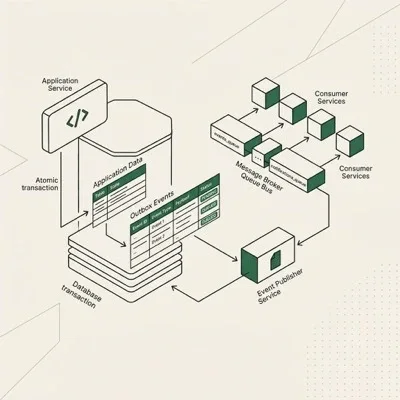
The Transactional Outbox pattern resolves the dual-write conundrum by converting the distributed write into a single, atomic local database transaction. Instead of attempting to communicate directly with both PostgreSQL and an external message broker within the same execution path, the application writes both the operational business entity and the corresponding domain event into the same relational database within the exact same ACID transaction.
Because relational databases like PostgreSQL guarantee atomicity (either all operations within a transaction commit or none do), it is physically impossible for the business record to exist without its corresponding outbox record, and vice versa. Once committed, a decoupled background publisher process asynchronously extracts records from the outbox table and relays them to the destination message broker with guaranteed at-least-once delivery.
The architecture consists of three core components:
1. The Outbox Table: A purpose-built relational table acting as a persistent append-only event buffer inside the operational database.
2. The Atomic Mutator: Application business logic that inserts domain entities and outbox events in a single BEGIN...COMMIT block.
3. The Message Relay: An independent worker that reads pending outbox events, dispatches them to Kafka, RabbitMQ, Redis Streams, or Amazon SQS, and marks them as processed or deletes them.
Engineering Breakdown: Relational Schema & Atomic Mutation
A high-performance outbox table must be designed for rapid sequential writes and efficient index scans that do not degrade as the table grows. In PostgreSQL, we implement the outbox schema with strict payload typing and deterministic sequencing:
CREATE TABLE outbox_events (
  id UUID PRIMARY KEY DEFAULT gen_random_uuid(),
  aggregate_type VARCHAR(64) NOT NULL,
  aggregate_id VARCHAR(128) NOT NULL,
  event_type VARCHAR(128) NOT NULL,
  payload JSONB NOT NULL,
  status VARCHAR(24) NOT NULL DEFAULT 'PENDING',
  retry_count INT NOT NULL DEFAULT 0,
  last_error TEXT,
  created_at TIMESTAMPTZ NOT NULL DEFAULT clock_timestamp(),
  processed_at TIMESTAMPTZ
);

CREATE INDEX idx_outbox_pending_events
ON outbox_events (created_at ASC)
WHERE status = 'PENDING';
Notice the use of a partial index (WHERE status = 'PENDING'). Because processed events quickly outnumber pending events, indexing only active items keeps the B-Tree index compact, ensuring index lookups execute in sub-millisecond time regardless of overall table volume.
Within your Node.js application, the business change and the event record are written in the same database transaction:
async function executeOrderTransaction(client, orderData) {
  await client.query('BEGIN');
  try {
    const insertOrderSql = `INSERT INTO orders (id, user_id, amount, status)
      VALUES ($1, $2, $3, $4) RETURNING *`;
    const orderRes = await client.query(insertOrderSql, [
      orderData.id, orderData.userId, orderData.amount, 'CONFIRMED'
    ]);

    const insertOutboxSql = `INSERT INTO outbox_events
      (aggregate_type, aggregate_id, event_type, payload)
      VALUES ($1, $2, $3, $4)`;
    await client.query(insertOutboxSql, [
      'Order', orderData.id, 'order.confirmed', orderRes.rows[0]
    ]);

    await client.query('COMMIT');
    return orderRes.rows[0];
  } catch (error) {
    await client.query('ROLLBACK');
    throw error;
  }
}
Publisher Strategies: Polling with SKIP LOCKED vs. Logical Decoding (CDC)
Once outbox records are committed, how does the message relay transport them to your broker? There are two common ways to do this:
1. Polling Publisher with FOR UPDATE SKIP LOCKED:
A background worker queries the outbox table at periodic intervals (e.g., every 250ms to 1,000ms). To allow multiple publisher workers to run concurrently across different Node.js processes without race conditions, PostgreSQL provides the FOR UPDATE SKIP LOCKED clause. Workers fetch a batch of records, lock them exclusively, publish them to the message broker, and update their status in a single sweep:
SELECT * FROM outbox_events
WHERE status = 'PENDING'
ORDER BY created_at ASC
LIMIT 100
FOR UPDATE SKIP LOCKED;
This approach completely eliminates lock contention: if Worker A is processing rows 1 through 100, Worker B immediately skips those rows and claims rows 101 through 200. It needs nothing beyond PostgreSQL and Node.js.
2. Transaction Log Tailing / Change Data Capture (CDC):
At very high volume (thousands of events per second), frequent polling queries can generate unnecessary I/O on your database. Change Data Capture reads PostgreSQL's Write-Ahead Log (WAL) via logical replication. Tools like Debezium or pgoutput capture mutations directly from the transaction log stream without executing SQL queries against the table. CDC adds very little delay or database load, but it introduces operational complexity: managing replication slots, preventing WAL bloat if consumers lag, and operating Debezium connectors.
Architectural Decision Matrix: Polling vs. CDC
Choosing between Polling with SKIP LOCKED and Change Data Capture depends on throughput, operational tolerance, and latency requirements:
Use the Polling Publisher Pattern (SKIP LOCKED) when:
• Event throughput is under 2,000 events per second.
• You want minimal operational complexity with no extra infrastructure (no Kafka Connect or Debezium clusters).
• Sub-second latency (250ms–500ms) is acceptable for asynchronous event dispatch.
• You want simple debugging and visibility directly within standard SQL queries.
Use Change Data Capture (CDC / Logical Decoding) when:
• Event throughput exceeds 5,000+ events per second.
• You cannot afford any database query polling overhead.
• Sub-50ms dispatch latency is an absolute operational requirement.
• Your engineering team already operates distributed event backbones (Apache Kafka, Debezium, Kubernetes operators).
Operational Trade-offs, Idempotent Consumers, and Pruning
Implementing the Transactional Outbox pattern guarantees at-least-once delivery. In distributed systems, at-least-once delivery inherently means duplicate messages will sometimes happen, for example when the publisher delivers a message to RabbitMQ but crashes before marking the outbox row as PUBLISHED.
Consequently, downstream consumers must be strictly idempotent. Every event payload must carry an immutable unique identifier (such as the outbox event id). Receiving consumers must record processed event IDs in an idempotency cache or database table before executing side-effects, discarding duplicate deliveries automatically.
Furthermore, outbox tables will accumulate millions of rows over time if left unmanaged. High-volume systems require an automated retention strategy:
1. Immediate Hard Deletion: If historical audit trails are handled elsewhere, the relay worker can directly DELETE outbox records upon successful publication rather than marking them PUBLISHED. This keeps table size virtually zero.
2. Partitioned Rolling Pruning: If event auditability is required for debugging, partition the outbox_events table by week using PostgreSQL declarative partitioning (PARTITION BY RANGE (created_at)). Old partitions can be dropped quickly via DROP TABLE without incurring expensive vacuuming penalties.
By treating database mutations and event emissions as a unified atomic transaction, the Transactional Outbox pattern permanently banishes ghost records, lost transactions, and silent distributed desynchronization from your web architecture.
Written by Lay Shah, an independent developer building websites and tools for small businesses. Discuss a brief More articles