Building webhook pipelines that do not lose data
Why form submissions, payment webhooks and automation syncs get lost under real traffic, and how to build a queue-backed pipeline with retries and a dead-letter queue so nothing is dropped.
- Topic
- Engineering
- Published
- Updated
- Reading time
- 8 min read
Every growing digital product or high-performance website eventually runs into the same operational trap: important business events are treated like ordinary web requests. A prospective enterprise client submits a custom quote form, Stripe sends an asynchronous checkout completion hook, or an ad platform delivers a batch of high-intent conversion records. In early architectures, the implementation is deceptively simple: the web endpoint receives the JSON payload, parses the body, awaits an external HTTP request to HubSpot, Salesforce, or Slack, and returns a 200 OK to the browser.
When traffic is modest, this synchronous pattern feels harmless. Response times hover around 400 to 600 milliseconds, and leads land in your sales pipeline. But as soon as marketing campaigns hit scale or third-party CRM APIs suffer intermittent degradation, this fragile architecture breaks down. Downstream APIs start returning 429 Too Many Requests or 504 Gateway Timeout. Serverless functions exhaust their execution budgets. Client connections drop mid-flight, and webhook dispatchers abandon unacknowledged deliveries.
The worst part of these failures is that they are completely silent. Your frontend analytics still track page views, but high-value customer inquiries evaporate without a trace in your operational databases. Recovering these lost opportunities requires awkward customer service outreach, manual reconciliations, and stressful forensic log diving. If your business depends on inbound leads or transactional workflows, you cannot afford to couple your public website directly to third-party availability.
Why Standard Integrations and No-Code Connectors Break Under Load
When engineering leads and technical founders recognize this vulnerability, they frequently turn to quick fixes: wrapping API calls in try-catch blocks, increasing serverless function timeout limits to 30 seconds, or offloading webhook distribution to visual automation platforms like Zapier or Make. While no-code tools are excellent for internal prototypes, relying on them as primary production ingestion engines introduces severe architectural bottlenecks.
First, visual automation platforms enforce strict concurrency limits and aggressive billing tiers. A sudden influx of form submissions during a keynote or ad surge can trigger immediate rate throttling or backpressure failures. Second, these tools rarely provide strict transactional guarantees. If a multi-step automation fails halfway through, for example by creating a contact in the database but never notifying sales, your systems are left out of sync with no automatic way to roll back.
Direct in-process retries on your primary web server fare no better. If your web process attempts to retry a failing CRM endpoint three times with linear delays, each incoming user request holds an active socket and memory allocation for 15 to 20 seconds. Under modest concurrency, your web tier runs out of worker threads, request queues back up, and your entire website becomes unresponsive to ordinary visitors. To build a system that scales reliably, you must decouple data ingestion from data processing.
The Three-Tier Architecture of a Resilient Ingestion Pipeline
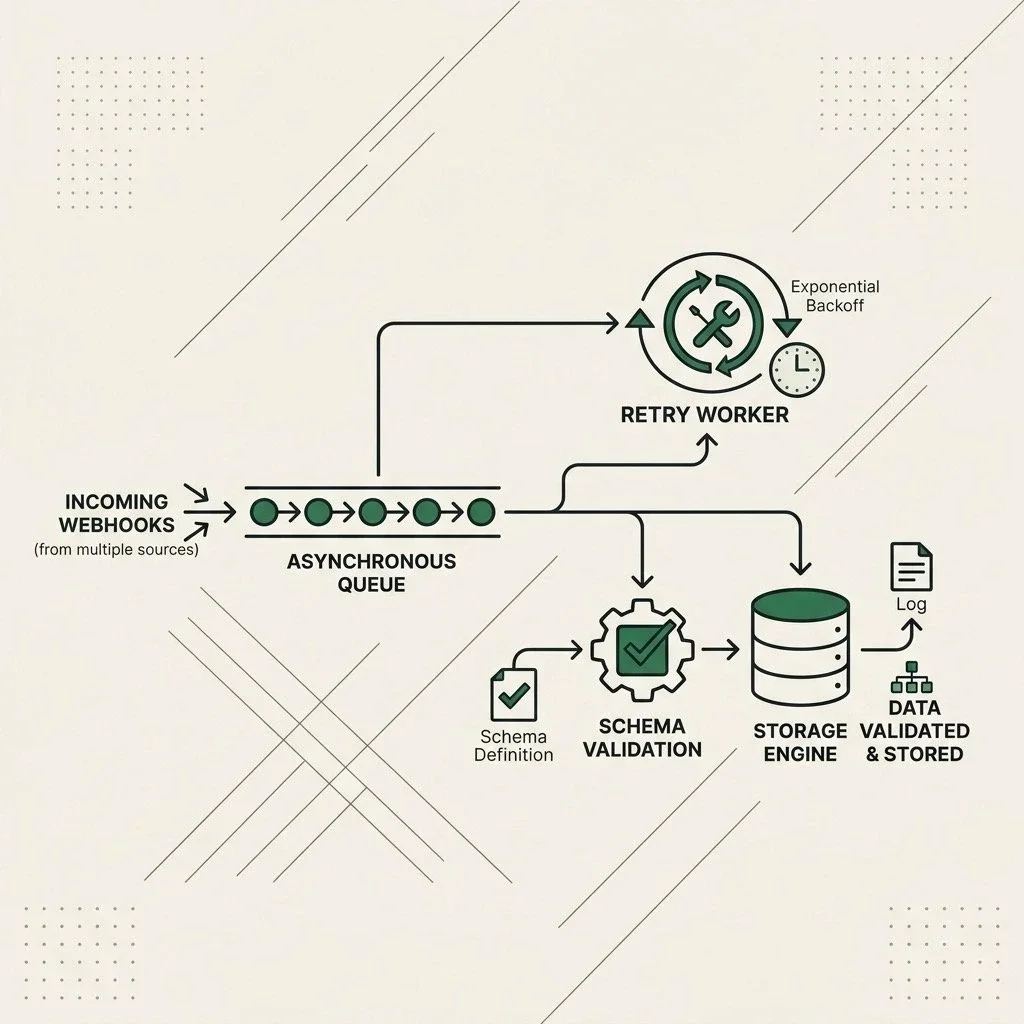
A reliable event pipeline separates responsibilities into three architectural layers: the Edge Ingestion Gateway, the Durable Event Buffer, and the Asynchronous Processing Consumer. This division guarantees that incoming webhooks are validated and stored durably within milliseconds, insulating producers from downstream hiccups.
1. Edge Ingestion Gateway: The webhook receiver's sole responsibility is fast ingestion. It verifies cryptographic signatures (such as HMAC-SHA256 headers), executes schema validation against expected fields using a strict parser like Zod, persists raw payloads into a durable buffer, and immediately responds with 202 Accepted or 200 OK. The round trip takes under 35 milliseconds. It never calls third-party APIs or performs heavy compute.
2. Durable Event Buffer: Once validated, the raw event must land in persistent storage before processing starts. Depending on your stack, this buffer can be an AWS SQS queue, a Redis Stream, or a PostgreSQL events table using FOR UPDATE SKIP LOCKED. What matters is durability: if consumer workers crash after acknowledgment, the event remains safely stored on disk.
3. Asynchronous Consumer Workers: Isolated background workers pull batches of events from the buffer. Workers parse payloads, enrich records with relational data, communicate with external CRM endpoints, and manage delivery confirmation. If an external service is down or rate-limiting traffic, backpressure is isolated to the queue; your web tier continues operating at peak speed.
Enforcing Idempotency and Deterministic Deduplication
In distributed systems, the golden rule of network transport is that network calls will occasionally fail, which means producers will inevitably retry requests. Platforms like Stripe, Shopify, and GitHub explicitly document that webhook deliveries are guaranteed to arrive at least once, but not necessarily only once. If your processing workers lack idempotency controls, a transient network hiccup could lead to duplicate invoices, duplicate CRM contact creation, or double-charged accounts.
Building an idempotent pipeline requires assigning a deterministic uniqueness key to every event before executing downstream side effects. If the provider includes a unique event identifier (such as Stripe's evt_1N...), use that directly. If dealing with generic contact forms, compute a SHA-256 fingerprint from fields that do not change between retries, such as the customer's email, the normalised company name and the time rounded to a five-minute window.
// Example: Atomic idempotency reservation in Node.js / TypeScript
async function processWebhookEvent(event: WebhookPayload): Promise {
  const idempotencyKey = event.id || generatePayloadHash(event);

  // Attempt atomic lock reservation with a 24-hour expiration window
  const acquired = await redis.set(
    `idempotency:${idempotencyKey}`,
    'IN_PROGRESS',
    'NX',
    'EX',
    86400
  );

  if (!acquired) {
    logger.warn(`Duplicate webhook detected, skipping: ${idempotencyKey}`);
    return;
  }

  try {
    await syncToExternalCRM(event);
    await redis.set(`idempotency:${idempotencyKey}`, 'COMPLETED', 'XX', 'KEEPTTL');
  } catch (error) {
    // Release key or mark failed so backoff retries can re-attempt cleanly
    await redis.del(`idempotency:${idempotencyKey}`);
    throw error;
  }
}
By enforcing this atomic check-and-set pattern in a distributed store like Redis or via unique database constraints in PostgreSQL (INSERT ... ON CONFLICT DO NOTHING), you eliminate duplicate execution regardless of how aggressively upstream services retry delivery.
Handling Failures: Exponential Backoff, Jitter, and Dead-Letter Queues
External dependencies will inevitably experience downtime. A resilient architecture handles these outages deterministically by categorizing errors into two distinct types: transient failures and permanent failures.
Transient failures include network socket timeouts, DNS resolution blips, and HTTP status codes 429 (Rate Limited), 502, 503, and 504. These errors indicate that the downstream service is temporarily overwhelmed or unreachable. When a worker encounters a transient error, the event should be requeued with exponential backoff and randomized decorrelated jitter: t_wait = min(max_interval, base * 2^attempt) + random_jitter. Jitter prevents the "thundering herd" problem, ensuring thousands of delayed messages do not hammer an API the instant it recovers.
Permanent failures, on the other hand, include invalid authentication tokens (HTTP 401), missing required fields (HTTP 422), or bad request formats (HTTP 400). Retrying these requests automatically is completely futile; no amount of delay will make an invalid API key work. When a permanent error occurs or when an event exceeds its maximum retry threshold (typically 5 to 7 attempts over 24 hours), the message must be routed directly to a Dead-Letter Queue (DLQ).
A Dead-Letter Queue is not an omission graveyard; it is an active operational inspection chamber. Each dead-letter record should store the raw incoming payload, the full stack trace of the last error, the HTTP status code, and the timestamp of every failed attempt. Your monitoring stack should trigger alerts on DLQ accumulation, allowing engineers to fix root causes (such as an expired API key or unexpected schema mutation) and execute a replay script that re-injects failed records cleanly into the queue.
Practical Architecture Decision Matrix and Checklist
Before implementing or refactoring your ingestion pipelines, evaluate your requirements against this operational decision checklist to select the right level of infrastructure complexity:
- Authentication & Signature Verification: Verify cryptographic signatures (HMAC) on the raw, unparsed request buffer before passing data to application logic.
- Payload Size Constraints: Reject requests exceeding a reasonable memory threshold (e.g., 256 KB for webhooks) immediately with HTTP
413 Payload Too Large. - Durable Storage Choice: For volumes under 50,000 events per day, a transactional PostgreSQL table with
SKIP LOCKEDis durable enough and needs no extra infrastructure. For higher concurrency or cross-cloud workflows, adopt AWS SQS or Redis Streams. - Observability & Tracing: Tag every incoming event with a unique
x-request-idand propagate it through queue metadata and outbound API calls for unified distributed tracing. - Replay Tooling: Ensure your team has a documented, tested CLI script or admin dashboard action to re-drive dead-letter messages without writing ad-hoc database queries.
Architectural Trade-offs and Next Steps
Every architectural choice carries trade-offs, and asynchronous event processing is no exception. Decoupling your web tier introduces eventual consistency: a user who submits a lead form will not see their record appear in your CRM in the exact millisecond they submit the page. In virtually every business context, an eventual sync delay of two to three seconds is vastly preferable to an unrecoverable 500 error.
Additionally, introducing message queues and background workers increases operational surface area. You must monitor queue lag, configure consumer scaling, and maintain dead-letter storage. For early-stage startups, building an over-engineered Apache Kafka cluster or complex microservice network is premature optimization. Start with the transactional outbox pattern inside your existing PostgreSQL database: write incoming leads to an events table in the same transaction that handles your core data, and poll that table with a lightweight Node.js or Go worker.
As your transaction volume and marketing footprint grow, transitioning from database tables to dedicated message brokers becomes a smooth, predictable migration. With clear boundaries, consumers that can safely run twice, and a dead-letter queue someone actually checks, the website stays fast for visitors and every lead, inquiry and payment is recorded.
Written by Lay Shah, an independent developer building websites and tools for small businesses. Discuss a brief More articles